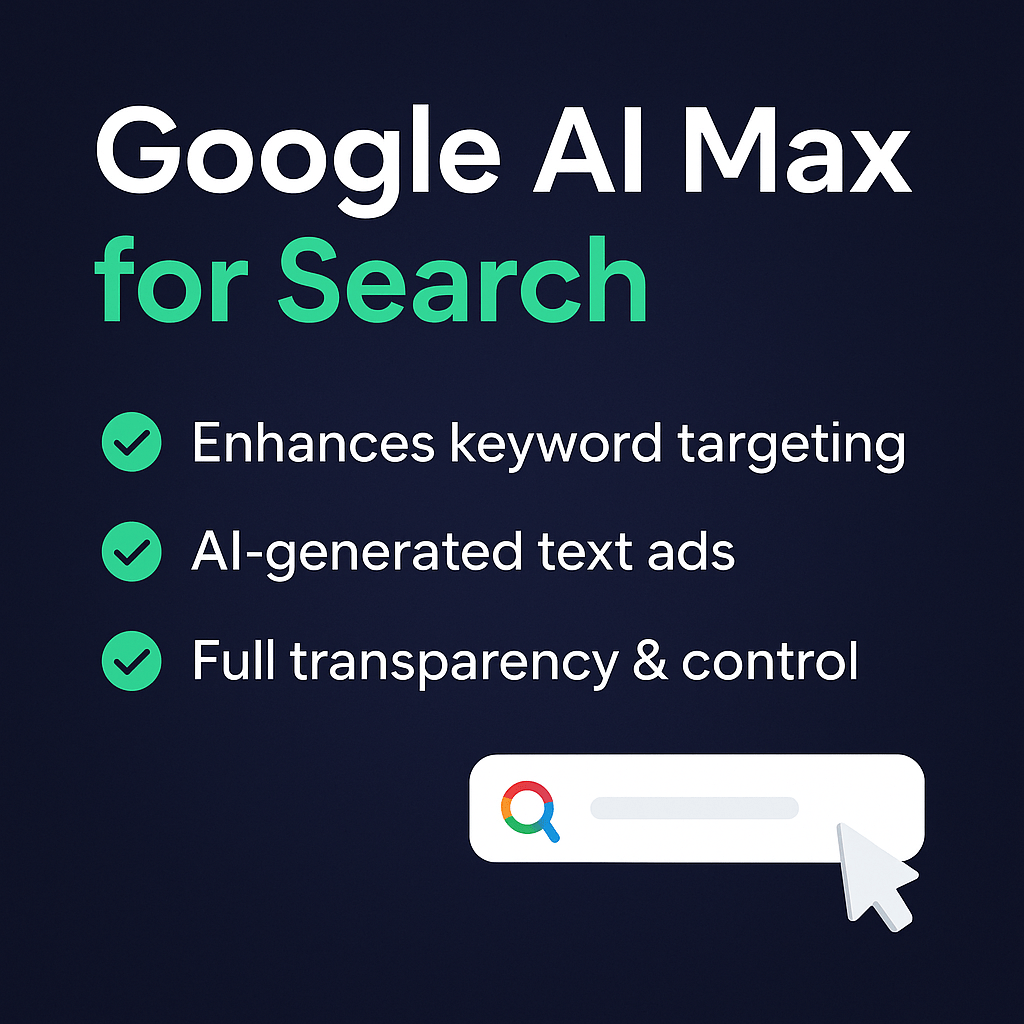
Google has introduced AI Max, a new optional optimization layer within standard Search campaigns that brings advanced AI enhancements to advertiser-familiar workflows — combining automation with transparency and control.
What Is AI Max?
AI Max is not a brand-new campaign type. Instead, it’s a powerful add-on layer you can enable within your existing Search campaigns. Essentially, it enhances keyword targeting and creative delivery with AI, offering advanced automation without abandoning structure.
Key features include:
- Search Term Matching: AI expands reach by blending broad match logic with “keywordless” targeting—leveraging your landing pages, ad assets, and keywords to find queries you may miss otherwise.
- Text Customization: Formerly known as Automatically Created Assets (ACA), this AI feature auto-generates headlines and descriptions based on your URLs, keywords, and ad copy.
- Final URL Expansion: Sends traffic to landing pages that best match user intent, with options to include or exclude URLs for better control.
Enhanced Controls and Transparency
AI Max prioritizes automation with transparency, offering tools to help you stay in control:
- New Reporting Tools: AI Max now shows up as its own match type in Search Terms reports. You can segment performance data (ROAS, CPA, CPC) specifically for AI-driven queries.
- Brand Controls: Set campaign- or ad-group-level inclusions and exclusions for brands to protect your messaging and context.
- Location of Interest Targeting: This lets you reach users based on geographical interest as well as location, offering more precise targeting at the ad-group level.
- Enhanced Asset and URL Reports: Get visibility into which assets and URLs AI is using, how they’re performing, and make real-time optimizations.
Early Results from Advertisers
Initial data from advertisers testing AI Max show promising outcomes:
- L’Oréal doubled conversion rates while reducing cost-per-conversion by around 31%, unlocking performance from previously untargeted queries like “best cream for dark spots”.
- MyConnect, an Australian utility service, saw a 16% increase in leads with a 13% lower cost-per-action. Net-new query conversions jumped by 30% after enabling AI Max.
Setup: How to Activate AI Max
Here’s how to add AI Max to your campaigns:
- In Google Ads, go to your existing or new Search campaign.
- Navigate to Campaign Settings and toggle AI Max to ON.
- Optionally enable:
- Search Term Matching
- Text Customization
- Final URL Expansion (requires text customization)
- Configure brand lists and URL rules as needed.
- Save and monitor performance—reports and metrics will highlight AI Max-driven data.
AI Max vs Performance Max
While both AI Max and Performance Max use Google’s automation and Smart Bidding, they serve different needs:
| Feature | AI Max (Search Layer) | Performance Max (Full-Funnel) |
|---|---|---|
| Campaign Type | Search campaign with AI enhancements | Multi-channel campaign type |
| Targeting Structure | Keyword + AI-powered broad and asset-based | Audience signals and assets-based |
| Transparency | Match type in reports; asset tracking | Cross-channel insights (less granular) |
| Control | Maintained via keywords and exclusions | Less control; AI handles placements |
| Best For | Search-first campaigns needing control | Scale across channels with reduced control |
AI Max preserves your ad structure while expanding reach; Performance Max unlocks full automation across Ad formats and networks.
Considerations Before You Activate
- AI Max is optional and modular—you can choose which features to enable based on your comfort and goals.
- Ideal for teams using Smart Bidding (e.g., tCPA, tROAS) and looking to scale search without losing transparency.
- Make sure your landing pages are optimized, as AI-driven customization relies on quality content.
- Ensure tight oversight—review AI-driven search term reports, asset performance, and exclude low-performing or sensitive URLs early on.
With AI Max, Google bridges the gap between hands-on SEM management and scalable AI automation. Advertisers gain reach and performance improvements while maintaining clarity and control.
It’s well-suited for those who want to scale search campaigns intelligently without abandoning campaign structure or transparency.