• Why SEO is Essential for Long-Term Business Success

    How SEO Can Help Your Business Grow

    In the digital age, having a stunning website isn’t enough. If your target audience can’t find you when they search online, it’s like owning a shop in the middle of the desert—no one knows you’re there. That’s where Search Engine Optimization (SEO) comes in. It’s the art and science of making your website visible to the people who matter most: potential customers.

    Let’s explore how SEO can transform your business and set you on the path to long-term growth.

    What is SEO?

    SEO, or Search Engine Optimization, is the process of improving your website to rank higher on search engines like Google, Bing, or Yahoo. When done right, SEO ensures that your website appears at the top of the search results when someone looks for products or services you offer.

    The magic of SEO lies in its ability to bring organic (free) traffic to your site—visitors who are actively searching for what you provide.

    How SEO Can Grow Your Business

    1. Boost Your Online Visibility

    SEO is all about getting your business in front of the right eyes. Think about it: when was the last time you clicked on the second page of Google? Exactly.

    By optimizing your site with the right keywords, meta descriptions, and content, SEO ensures you show up where your customers are looking.

    For example:

    • A local bakery optimizing for “best cupcakes near me” can attract nearby customers searching for a sweet treat.

    2. Drive High-Quality Traffic

    The beauty of SEO is that it targets users who are actively looking for what you offer. Unlike paid ads, where you push your message to an audience, SEO pulls people in. This means the traffic you get is more likely to convert.

    For example:

    • A real estate agency optimizing for “affordable homes in Austin” will attract potential buyers ready to make a move.

    3. Build Trust and Credibility

    Ranking high on search engines signals to users that your business is trustworthy and reputable. People tend to trust Google, and if you’re on the first page, they’re more likely to trust you too.

    For instance:

    • A fitness trainer with a website optimized for “personal training tips” can establish authority in their field, encouraging visitors to book sessions.

    4. Deliver Long-Term Results

    Unlike paid ads, which stop delivering as soon as you stop paying, the benefits of SEO compound over time. A well-optimized blog post or product page can continue to attract traffic for months or even years.

    Imagine:

    • An eco-friendly brand writing an evergreen blog post like “10 Ways to Reduce Plastic Waste.” This post can rank and generate consistent traffic long after it’s published.

    5. Stay Ahead of the Competition

    Your competitors are likely investing in SEO, and if you’re not, you risk being left behind. By optimizing your site, you can compete with (and even outrank) bigger players in your industry.

    For example:

    • A local boutique optimizing for “handmade jewelry near me” can outshine larger retailers targeting the same keyword.

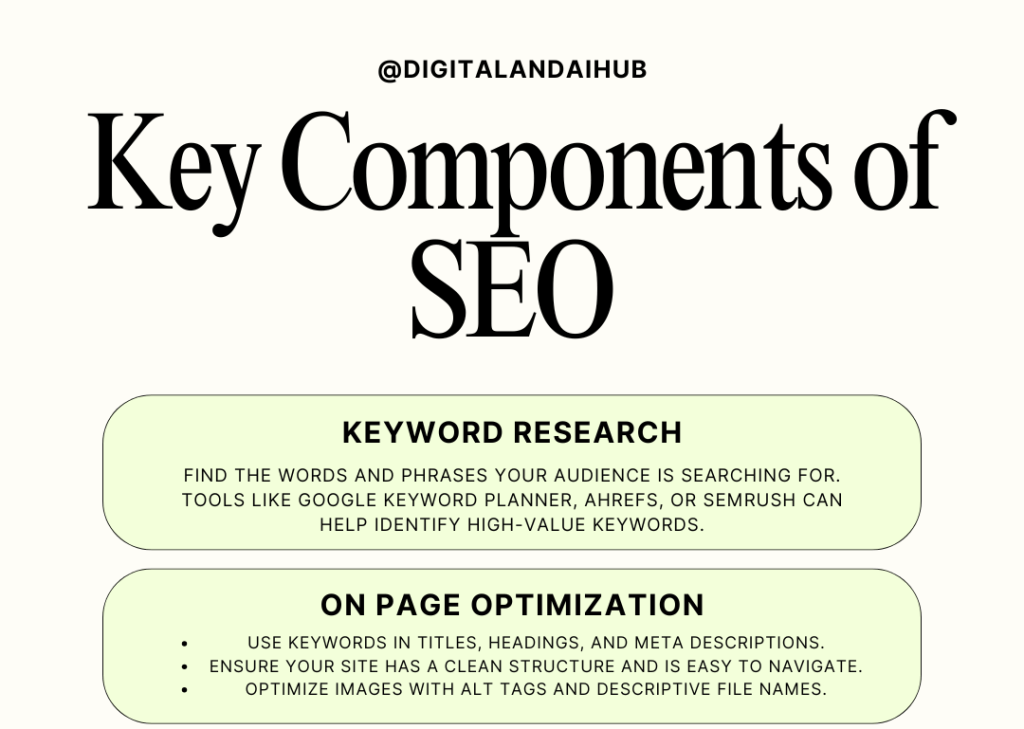
    Key Components of SEO

    1. Keyword Research Find the words and phrases your audience is searching for. Tools like Google Keyword Planner, Ahrefs, or SEMrush can help identify high-value keywords.
    2. On-Page Optimization
      • Use keywords in titles, headings, and meta descriptions.
      • Ensure your site has a clean structure and is easy to navigate.
      • Optimize images with alt tags and descriptive file names.
    3. Content Creation Create high-quality, relevant content that answers your audience’s questions. Blog posts, how-to guides, and product descriptions are great places to start.
    4. Technical SEO
      • Ensure your site is mobile-friendly and loads quickly.
      • Fix broken links and optimize for secure connections (HTTPS).
      • Use structured data to help search engines understand your content.
    5. Backlink Building Earn links from other reputable websites. These act as “votes of confidence” for your site, helping boost your rankings.
    6. Local SEO If you’re a local business, optimize for location-specific keywords and set up a Google My Business profile.

    The ROI of SEO

    SEO is an investment, not an expense. It takes time to see results, but the payoff is worth it. Businesses that consistently optimize their sites often see:

    • Increased website traffic.
    • Higher conversion rates.
    • Lower customer acquisition costs compared to paid ads.

    For instance:

    • A travel agency ranking for “family vacation packages” can save on ad spend while attracting a steady stream of organic leads.

    Why Your Business Needs SEO

    In today’s competitive landscape, having a website isn’t enough—it needs to work for you. SEO ensures that your site isn’t just a digital brochure but a powerful tool for attracting, engaging, and converting customers.

    Whether you’re a small business owner looking to grow locally or an e-commerce brand aiming for global reach, SEO is your ticket to sustainable, long-term growth.

    Final Thoughts

    SEO isn’t just about ranking higher; it’s about connecting with your audience when they need you most. It’s about being the solution to their problem, the answer to their question, or the product they didn’t know they needed.

    So, where will SEO take your business next? Start optimizing today and watch your business grow, one search result at a time.

    Have you implemented SEO strategies for your business? Share your successes (or challenges) in the comments below—I’d love to hear your story!
  • How Paid Social Advertising Boosts Brand Awareness

    How Paid Social Can Drive Growth for Your Business

    In a world where billions of people scroll through social media daily, paid social advertising has become a game-changer for businesses of all sizes. Whether you’re a boutique clothing brand, a local coffee shop, or a global tech company, paid social provides the tools to target your ideal customers and achieve real, measurable growth.

    Let’s break down how paid social works, why it’s so effective, and how you can leverage it to take your business to the next level.

    What is Paid Social?

    Paid social refers to the practice of running ads on social media platforms like Facebook, Instagram, LinkedIn, Twitter, and TikTok. These ads are displayed to specific audiences based on parameters like demographics, interests, and behaviors.

    Unlike organic social media marketing, where you rely on followers seeing and engaging with your posts, paid social ensures your content reaches a larger, targeted audience—regardless of whether they follow you or not.

    Why Paid Social Works

    Social media platforms know a lot about their users, from their favorite brands to their hobbies and spending habits. Paid social takes advantage of this data to connect businesses with the right audience. It’s a way to meet potential customers where they’re already spending time—scrolling through their feeds.

    5 Ways Paid Social Can Grow Your Business

    1. Laser-Focused Targeting

    Paid social allows you to define your audience with pinpoint accuracy. Whether you’re targeting a 25-year-old yoga enthusiast in New York or a 50-year-old entrepreneur in London, you can create campaigns tailored to their interests, behaviors, and even life events.

    For example:

    • A wedding planner can target users recently engaged.
    • A baby product company can target new parents.
    • A luxury travel agency can target high-income individuals who’ve shown interest in travel.

    2. Boost Brand Awareness

    If people don’t know your brand exists, they can’t buy from you. Paid social ads are an effective way to introduce your business to potential customers. Platforms like Instagram and TikTok are particularly powerful for building visual connections with users, showcasing your brand’s personality, and grabbing attention.

    Imagine a local candle shop running a stunning video ad featuring their hand-poured candles, sparking interest among viewers who love home decor.

    3. Drive Immediate Traffic and Conversions

    Paid social is all about results, and it can drive both traffic and sales quickly. With enticing visuals and compelling calls-to-action (CTAs), you can direct users to your website, landing page, or even a specific product.

    For instance:

    • An online boutique can promote a “limited-time sale” ad on Instagram Stories, driving shoppers to their site.
    • A SaaS company can run a LinkedIn ad offering a free trial, generating high-quality leads.

    4. Retarget Customers Who Didn’t Convert

    One of the most powerful features of paid social is retargeting. Ever noticed how ads for that pair of shoes you almost bought seem to follow you everywhere online? That’s retargeting at work. It reminds users of what they left behind and encourages them to take action.

    For example:

    • A fitness brand can retarget users who abandoned their cart with an ad offering free shipping.
    • A travel company can remind visitors of a flight deal they browsed but didn’t book.

    5. Measurable Results and Insights

    Paid social campaigns provide detailed performance metrics, so you’ll always know what’s working and what’s not. From impressions and clicks to conversions and ROI, the data helps you refine your strategy and make better marketing decisions.

    For example:

    • If an ad targeting “young professionals” outperforms one targeting “students,” you can adjust your budget accordingly.
    • By analyzing click-through rates, you can test and optimize different headlines, visuals, and offers.

    Tips for Successful Paid Social Campaigns

    1. Know Your Audience: Use the insights provided by platforms to define your ideal customer. Create audience segments based on age, gender, location, interests, and behaviors.
    2. Focus on Creative: Visuals are the first thing users notice, so invest in high-quality images or videos that capture attention. Use bold text, vibrant colors, and striking imagery.
    3. Use Clear CTAs: Your ad should tell people exactly what to do next—“Shop Now,” “Sign Up,” or “Learn More.” Make it easy for them to take action.
    4. Experiment and Test: Test different ad formats, headlines, and targeting options. Use A/B testing to see what resonates with your audience.
    5. Optimize for Mobile: Most social media users are on their phones, so ensure your ads look great on mobile devices.

    Popular Platforms for Paid Social

    • Facebook & Instagram: Great for reaching diverse audiences, offering advanced targeting and multiple ad formats like Stories, Reels, and carousel ads.
    • LinkedIn: Perfect for B2B businesses, allowing you to target professionals based on job title, industry, and more.
    • TikTok: Ideal for creative, visually-driven brands looking to tap into a younger, highly engaged audience.
    • Twitter: Useful for promoting timely offers and engaging in trending conversations.
    • Pinterest: Best for lifestyle and e-commerce brands, especially in niches like fashion, home decor, and food.

    Why Your Business Needs Paid Social

    The simple truth? Your audience is already on social media. Paid social helps you cut through the noise, ensuring your message gets in front of the people who matter most to your business. Whether you’re looking to build awareness, drive traffic, or close sales, paid social is a powerful, cost-effective way to achieve your goals.

    So, what are you waiting for? Start exploring paid social today, and watch your business grow—one click at a time.

  • Boost Your Business with Paid Search Strategies

    How Paid Search Can Help Your Business Grow

    In today’s digital world, where every click counts, businesses are constantly searching for ways to boost their online presence, attract new customers, and drive revenue. Enter Paid Search, one of the most effective tools in the digital marketing arsenal. If you’ve ever wondered how those ads at the top of Google search results work or how they can benefit your business, you’re in the right place.

    Let’s dive into how paid search works and why it’s a game-changer for businesses of all sizes.

    What is Paid Search?

    Paid search, often referred to as Pay-Per-Click (PPC) advertising, allows businesses to bid for ad placements on search engine results pages (SERPs). When someone searches for keywords related to your business, your ad can appear at the top of the results, giving you prime real estate in the digital landscape.

    But here’s the best part: you only pay when someone clicks on your ad. It’s a win-win for businesses looking to maximize their marketing dollars.

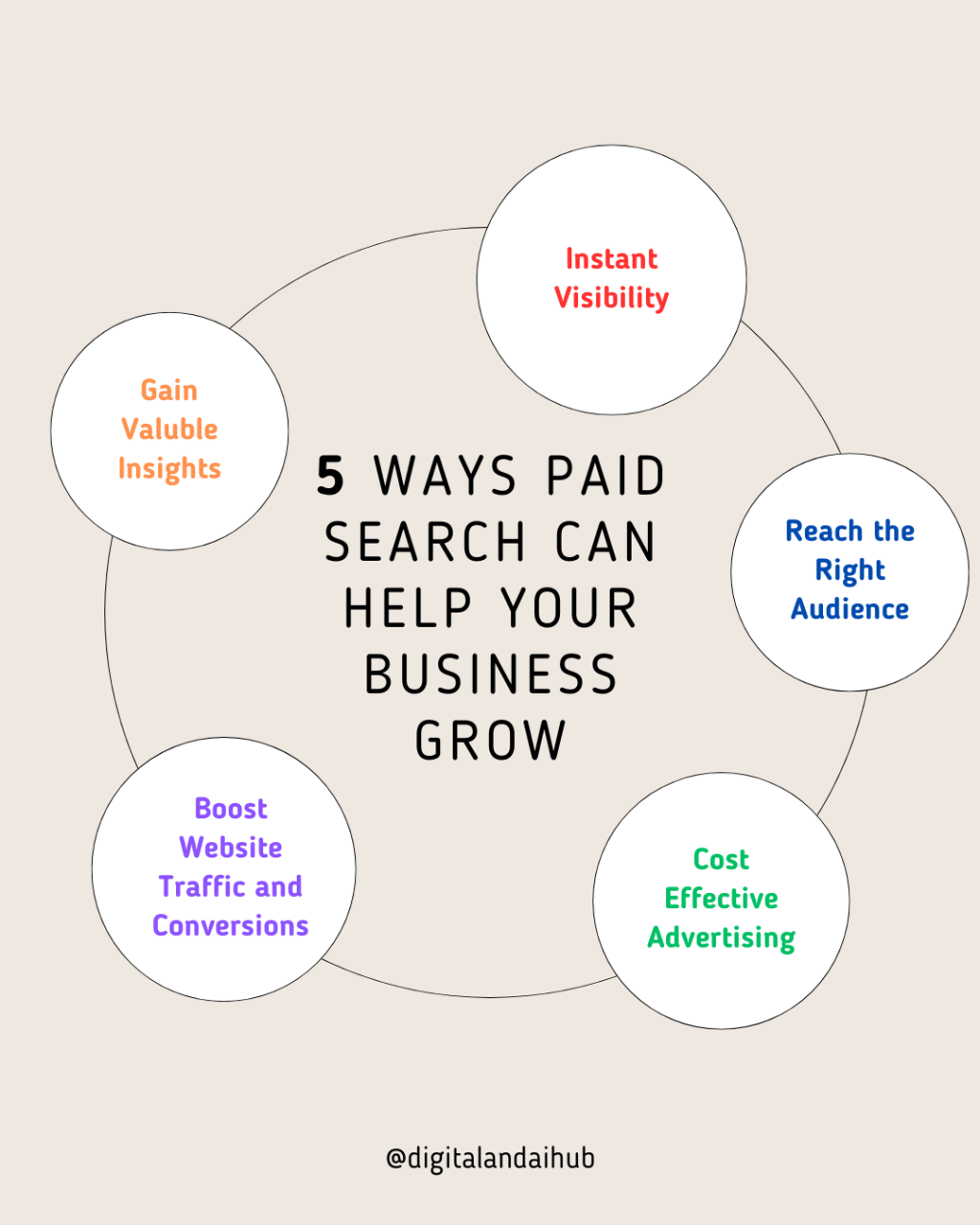
    5 Ways Paid Search Can Help Your Business Grow

    1. Instant Visibility

    Organic SEO strategies are powerful but can take months to yield results. Paid search, on the other hand, offers immediate visibility. As soon as your campaign is live, your ads can appear at the top of search results, giving your business instant exposure to potential customers.

    Imagine a small bakery launching a new line of gluten-free products. With paid search, they can target terms like “best gluten-free bakery near me” and attract customers right away.

    2. Reach the Right Audience

    One of the biggest strengths of paid search is its ability to target specific audiences. You can customize your campaigns to focus on:

    • Geographic locations: Target people in your city, state, or even a specific post/zip code.
    • Demographics: Tailor your ads based on age, income, or interests.
    • Keywords: Reach users who are actively searching for your products or services.

    For example, a local fitness studio can target “beginner yoga classes” to attract new students within a 10-mile radius.

    3. Cost-Effective Advertising

    Paid search is as flexible as it gets. You set your own budget and can scale up or down as needed. Plus, with detailed analytics, you can track exactly how much you’re spending and the return on investment (ROI) you’re getting.

    For instance, an e-commerce brand might discover that a $500 investment in paid search generates $5,000 in sales. With numbers like that, it’s easy to see why businesses love PPC.

    4. Boost Website Traffic and Conversions

    Paid search isn’t just about driving traffic; it’s about attracting the right traffic. By targeting high-intent keywords—searches that indicate someone is ready to buy—you can bring people to your site who are more likely to convert.

    Picture a boutique hotel advertising with keywords like “luxury hotel deals.” These are customers who aren’t just browsing—they’re looking to book.

    5. Gain Valuable Insights

    Every click, impression, and conversion in a paid search campaign provides insights into your customers’ behavior. These analytics can help you:

    • Identify which keywords are driving the most traffic.
    • Understand which ads are performing best.
    • Refine your overall marketing strategy.

    Even if a user doesn’t convert immediately, their actions can provide valuable data for retargeting campaigns, ensuring your business stays top-of-mind.

    Tips for Successful Paid Search Campaigns

    1. Choose the Right Keywords: Use tools like Google Keyword Planner to find keywords that match your business goals and have high intent.
    2. Optimize Your Ad Copy: Craft compelling headlines and descriptions that resonate with your audience.
    3. Set a Clear Budget: Start small and increase your budget as you see results.
    4. Use Landing Pages Wisely: Ensure your ads direct users to relevant, optimized landing pages for better conversions.
    5. Monitor and Adjust: Paid search isn’t a “set it and forget it” strategy. Regularly analyze performance and tweak your campaigns to improve results.

    Why Now is the Time to Invest in Paid Search

    With more consumers relying on search engines to discover businesses, the importance of paid search has never been greater. Whether you’re a startup looking to build brand awareness or an established company aiming to dominate your niche, paid search offers the flexibility, scalability, and precision needed to grow your business.

    In short, if you want to meet your customers where they are—actively searching for what you offer—paid search is the way to go.

    So, what’s stopping you? Take that first step into the world of paid search, and watch your business grow faster than you ever thought possible.

    Have you tried paid search for your business? Share your experiences in the comments—I’d love to hear how it’s working for you!

  • Perplexity’s AI Ads: A New Era for Digital Marketing

    In the ever-evolving landscape of digital marketing, AI-driven platforms are continually reshaping how brands connect with audiences. A recent development in this arena is Perplexity’s introduction of sponsored follow-up questions, marking its foray into advertising.

    Perplexity’s Advertising Initiative

    Perplexity, an AI-powered answer engine, has begun testing ads in the form of sponsored follow-up questions. These ads are clearly labeled as “sponsored” and appear alongside the main answer, providing users with additional, relevant information. Importantly, the responses to these sponsored questions are generated by Perplexity’s AI, ensuring consistency and neutrality in the information presented. They look very native!

    Implications for Digital Marketers

    This move opens new avenues for brands to engage with a tech-savvy audience. Perplexity reports handling approximately 100 million search queries weekly, offering a substantial platform for advertisers. Early participants in this advertising program include Indeed, Whole Foods Market, Universal McCann, and PMG, indicating a growing interest in leveraging AI-driven platforms for marketing purposes.

    User Demographics and Engagement

    Perplexity’s user base is notably educated and professionally established, with 80% holding undergraduate degrees and 30% in senior leadership positions. Additionally, 65% are in high-income white-collar professions such as medicine, law, and software engineering. This demographic profile suggests that advertising on Perplexity could effectively reach decision-makers and professionals seeking informed insights.

    Balancing User Experience and Monetization

    While integrating ads, Perplexity emphasizes maintaining a user-centric experience. The company acknowledges that subscriptions alone may not sustain a revenue-sharing model with publisher partners, making advertising a necessary component. By ensuring that sponsored content is clearly labeled and that responses are AI-generated, Perplexity aims to balance monetization with the integrity of user experience.

    Conclusion

    Perplexity’s venture into sponsored follow-up questions represents a significant step in AI-driven digital marketing. For marketers, this development offers a novel platform to engage a discerning audience through innovative advertising formats. As AI continues to influence marketing strategies, platforms like Perplexity provide valuable opportunities to connect with users in meaningful ways.

    Source: Perplexity begins testing ads as sponsored follow-up questions

  • Revolutionizing Digital Marketing with AI

    How AI is Revolutionizing the Digital Marketing Landscape

    Imagine this: you’re scrolling through your favorite social media app, and an ad pops up for a pair of hiking boots you were casually browsing two days ago. It feels uncanny, almost like the internet is reading your mind. But the truth is, it’s not magic—it’s AI in action, quietly reshaping the way digital marketing works.

    As someone who’s always been fascinated by the intersection of technology and creativity, I’ve seen firsthand how artificial intelligence is taking the digital marketing game to levels we never thought possible. Let me walk you through this revolution.

    The Rise of the Machines (In a Good Way)

    AI in digital marketing isn’t just about chatbots or targeted ads (though those are cool, too). It’s a behind-the-scenes wizard, analyzing mountains of data at lightning speed to predict what you’ll want before you even know it yourself. For marketers, this means a shift from broadcasting to narrowcasting—reaching the right people, at the right time, with the right message.

    Hyper-Personalization: Because One Size Doesn’t Fit All

    Think about the last time you got an email that felt like it was written just for you. AI is the engine behind that magic. It sifts through your preferences, online behaviors, and past purchases to craft a message that feels personal and relevant.

    For instance, Netflix uses AI to recommend your next binge-worthy show, and Spotify curates playlists that feel like they’re plucked straight from your soul. This same principle applies to marketing—brands are no longer shouting into the void; they’re whispering directly into your ear.

    Predictive Analytics: Reading the Future, One Click at a Time

    AI doesn’t just analyze what’s happening now—it predicts what’s next. Marketers can now use predictive analytics to forecast trends, optimize campaigns, and even anticipate customer churn. It’s like having a crystal ball, except it’s powered by algorithms and a lot of data crunching.

    A personal favorite example? AI can determine the best time to send an email to maximize open rates or predict which products are likely to fly off the virtual shelves during a holiday sale.

    Chatbots and Virtual Assistants: The New Customer Service Reps

    If you’ve ever been greeted by a chatbot on a website, you’ve encountered one of AI’s most visible contributions to digital marketing. These virtual assistants are like tireless customer service reps, available 24/7 to answer questions, guide purchases, or even upsell you on that extra pair of socks.

    What’s amazing is how sophisticated these bots have become. They’re no longer just rule-based systems—they use natural language processing to hold actual conversations, making them feel less like robots and more like helpful friends.

    Content Creation: When AI Becomes the Writer

    This one’s close to my heart because, let’s face it, the idea of machines writing blogs can feel a little unnerving, especially as I have another blog, Adventures of Zach. But AI isn’t here to replace us writers—it’s here to lend a helping hand. Tools like Jasper and Copy.ai can generate headlines, suggest keywords, and even draft posts. The best part? They free up time for us to focus on the creative, human elements of storytelling.

    The Dark Side: Balancing AI with Authenticity

    Of course, it’s not all sunshine and rainbows. Relying too heavily on AI can sometimes lead to over-automation, where marketing feels robotic and impersonal. Nobody likes a cold, cookie-cutter experience. The key is finding that sweet spot where technology amplifies, rather than overshadows, the human touch.

    Final Thoughts: Where Do We Go From Here?

    As someone who loves exploring the new and the next, I’m thrilled to see how AI is transforming digital marketing. It’s making the industry smarter, more efficient, and yes—more exciting. But at the heart of it all, it’s still about connection. AI might be the brains behind the operation, but the heart? That’s all human.

    So, whether you’re a marketer looking to up your game or just a curious explorer of the digital world, now’s the time to embrace the AI revolution. Who knows? The next ad you see might just feel like it was designed with you in mind—because it probably was.

    What’s your take? How have you seen AI shaping your online experiences? Let’s chat about it in the comments below!

  • Transform Your Ecommerce with AI Innovations

    How AI is Shaping the Future of Ecommerce

    AI is revolutionizing ecommerce, offering smarter ways to personalize customer experiences, streamline operations, and increase sales. Here’s how you can harness AI to transform your online store.

    1. AI-Powered Personalization. AI tools analyze user behavior to recommend products tailored to individual preferences, increasing conversions.

    2. Chatbots and Customer Support. Automated chatbots can handle FAQs, assist with purchases, and provide 24/7 support, reducing operational costs.

    3. Inventory and Pricing Optimization. AI predicts demand and adjusts prices dynamically to maximize profitability and avoid overstocking.

    4. Predictive Analytics. AI forecasts future trends, helping you optimize your inventory, marketing strategies, and customer acquisition efforts.

    AI is the key to staying competitive in ecommerce. Use the contact form or subscribe to the newsletter to find out to how you can integrate AI into your business and scale faster!

  • Boost Your Social Media Strategy for Success

    The Importance of a Strong Social Media Content Strategy

    Social media success doesn’t happen by accident—it starts with a strategy. Here’s how to create a content plan that drives engagement and delivers results.

    1. Setting Clear Objectives. Decide whether your goals are to grow followers, increase engagement, or drive website traffic.

    2. Understanding Your Audience. Use analytics to understand your audience’s preferences, and tailor content to their interests.

    3. Content Mix. Balance promotional posts with educational and entertaining content to keep your audience engaged.

    4. Timing and Consistency. Plan your posts using scheduling tools to maintain a consistent presence and optimize posting times.

    5. Measuring Success. Track metrics like reach, engagement, and conversions to refine your strategy and achieve better results.

    A strong social media strategy builds your brand and strengthens your connection with your audience. Subscribe to the newsletter or fill in the contact form to find out about how to elevate your social presence.

  • Paid Social Advertising: How to Maximize ROI on a Budget

    Paid social advertising offers unparalleled opportunities to reach your audience, but managing costs while maximizing ROI can be tricky. Here are actionable strategies to run cost-effective campaigns and make every penny count.

    1. Choosing the Right Platform. Not all platforms suit every business. LinkedIn is ideal for B2B, while Instagram and TikTok excel in visual storytelling. Focus your budget where your audience spends the most time.

    2. Setting Clear Objectives. Define whether you want to drive awareness, engagement, or conversions. Tailor your campaigns to match these goals for better ROI.

    3. Creative Best Practices. Capture attention with bold visuals and engaging ad copy. Test multiple creatives to see what resonates best with your audience.

    4. Audience Segmentation. Use retargeting and lookalike audiences to target the most relevant users. This ensures your ads are reaching those most likely to convert.

    5. Data-Driven Optimization. Monitor analytics regularly and adjust bids, targeting, and creatives to improve performance over time.

    With careful planning and continuous optimization, paid social can deliver incredible value even on a tight budget. Let’s discuss how to elevate your campaigns to the next level.

  • 5 SEO Trends You Can’t Afford to Ignore in 2024

    Search Engine Optimization (SEO) is constantly evolving, and what worked yesterday might not work tomorrow. To stay competitive in 2024, you need to stay ahead of the trends. Here are five key SEO trends shaping the digital landscape and how you can leverage them to rank higher and attract more traffic.

    1. AI-Driven Content Optimization. AI-powered tools like Jasper and SurferSEO are helping marketers create content tailored to search intent. These tools analyze keywords, competitor content, and structure to deliver highly optimized articles that rank better.

    2. E-E-A-T: Experience, Expertise, Authority, and Trustworthiness. Google’s emphasis on E-E-A-T means content creators must focus on providing real value. Building authority through quality backlinks and expertise-driven content is more critical than ever.

    3. Voice Search and Natural Language Queries. With the rise of smart assistants like Alexa and Google Assistant, optimizing for conversational queries is key. Use long-tail keywords and question-based content to rank for voice search.

    4. Video and Visual Search. Platforms like YouTube and Google Lens are driving traffic through video and image search. Creating optimized video content and adding alt text to images is essential to capitalize on this trend.

    5. Core Web Vitals and User Experience. Google continues to prioritize website speed, responsiveness, and visual stability. Regularly audit your site’s performance using tools like PageSpeed Insights to ensure a smooth user experience.

    By embracing these trends, you can future-proof your SEO strategy and maintain a competitive edge. Need help implementing these strategies? Let’s connect and boost your SEO game for 2024!

  • The Future of Paid Search: How AI is Revolutionizing PPC Advertising

    Paid search remains a cornerstone of digital marketing, offering businesses a fast and measurable way to reach their audience. But as the digital landscape evolves, so does the technology behind it. AI is rapidly transforming paid search campaigns, providing smarter automation, predictive insights, and better ROI. Here’s how AI is revolutionizing the world of PPC advertising and how you can harness its power.

    1. The Evolution of Paid Search. From manual keyword bidding (oh dear…I remember those…) to today’s AI-driven campaigns (yes smart bidding counts!), paid search has come a long way. AI has allowed marketers to move beyond guesswork, focusing on real-time data and actionable insights to make campaigns more effective.

    2. AI-Powered Automation. AI tools like Google Ads’ Smart Bidding analyze vast amounts of data to optimize bids based on user behavior, intent, and conversion potential. This reduces the need for constant manual adjustments and ensures your budget is spent where it matters most. Make the most of these, data shows performance increases from the moment they’re implemented.

    3. Predictive Analytics. AI allows marketers to predict trends, customer behavior, and seasonal opportunities. Tools like MarinOne and Skai analyze historical data to forecast campaign outcomes, helping you stay ahead of the competition. However they are not free!

    4. Best Practices for Integrating AI While automation can handle repetitive tasks, strategic oversight is still essential. Combine AI with manual insights for creative direction, audience segmentation, and ad copy personalization. AI and human input together is what produces results!

    5. Future Trends The integration of AI with voice search, visual search, and conversational AI is on the rise. Prepare for campaigns that respond seamlessly to these emerging technologies and make sure you have assets for these!

    AI is no longer a futuristic concept—it’s the present and future of paid search. By leveraging AI tools, businesses can achieve greater efficiency, precision, and results. Ready to take your PPC campaigns to the next level?

    Fill in the contact form to explore how AI can drive your success.